
The Louvre Paris, France
The Louvre isn’t just a museum it’s a global icon. Housed in a former royal palace, it blends grandeur with grit, tracing art history from ancient civilizations to the 19th century. Inside, you’ll find the Mona Lisa and Venus de Milo two pieces that pull in millions every year. But those are only the beginning.
Walking through the museum is like moving through time. One minute, you’re staring down a Mesopotamian lion; the next, you’re standing under vaulted ceilings admiring French neoclassicism. It’s easy to get lost here and that’s kind of the point.
To avoid getting overwhelmed, it pays to do a little homework. Start with this virtual guide: Inside the Louvre: A Guided Tour of Its Most Iconic Paintings. It’ll help you move with purpose once you’re there.
The Uffizi Gallery Florence, Italy
Florence wasn’t just a backdrop for the Renaissance it was the engine room. And nowhere captures that legacy more vividly than the Uffizi Gallery. Originally designed as administrative offices, the space evolved into one of the most important art galleries in the world. Walk its corridors and you’re nose to canvas with icons: Botticelli’s “The Birth of Venus,” da Vinci’s early genius, and portraits sculpted in paint by Michelangelo himself. The collection isn’t just impressive it’s foundational.
But know this: the Uffizi draws crowds. Lots of them. To sidestep the grind of snaking tourist lines, timing is everything. Go midweek Tuesday or Thursday mornings are typically calmer and aim for off season months like late January or early November. Booking timed entry tickets in advance isn’t optional anymore. It’s survival.
For art lovers, the Uffizi isn’t a box to check it’s a rite of passage. Give it the slow burn it deserves.
The Metropolitan Museum of Art New York City, USA
The Met doesn’t do small. With over 2 million pieces covering 5,000+ years of human creativity, it’s less of a gallery and more of a time machine. One minute, you’re staring up at the Egyptian Temple of Dendur actual sandstone walls, columns, and all. The next, you’re face to face with Van Gogh’s intense, searching self portrait.
But the Met isn’t just resting on its classics. Each year through 2026, it’s rolling out major thematic exhibitions designed to shake up how we think about art. These aren’t your standard museum fare. Think bold questions about identity, climate, and technology with the art to match. Whether you’re a first time visitor or a regular, there’s always something new to stumble into.
If you’re hitting just one gallery in the U.S., this is the one that covers the most ground historically, artistically, and culturally.
The Prado Museum Madrid, Spain
The Prado isn’t just a gallery it’s a cornerstone of Spanish culture. Inside, you’ll find works that go beyond skill and beauty. Goya’s intense black paintings, Velázquez’s razor sharp realism, and El Greco’s mystic distortions don’t just hang quietly they communicate the soul of Spain, from royal grandeur to raw inner conflict.
This is where you see history and identity woven into the brushstrokes. Velázquez’s “Las Meninas” isn’t just a portrait; it’s a commentary on power and the observer. Goya’s “The Third of May 1808” doesn’t spare you from the brutality of war. El Greco, with his stretched, glowing figures, bridges the earthly and the divine like nobody else could.
Planning a stop? Aim for the evening hours after 6 p.m., entry is free and the crowds thin out. If time’s tight, pick one or two wings and pace yourself. The museum layout helps: artists are grouped together, so you can focus your attention without zig zagging across the building. Whether you’ve got an hour or a day, even a quick walk through the Prado leaves a mark.
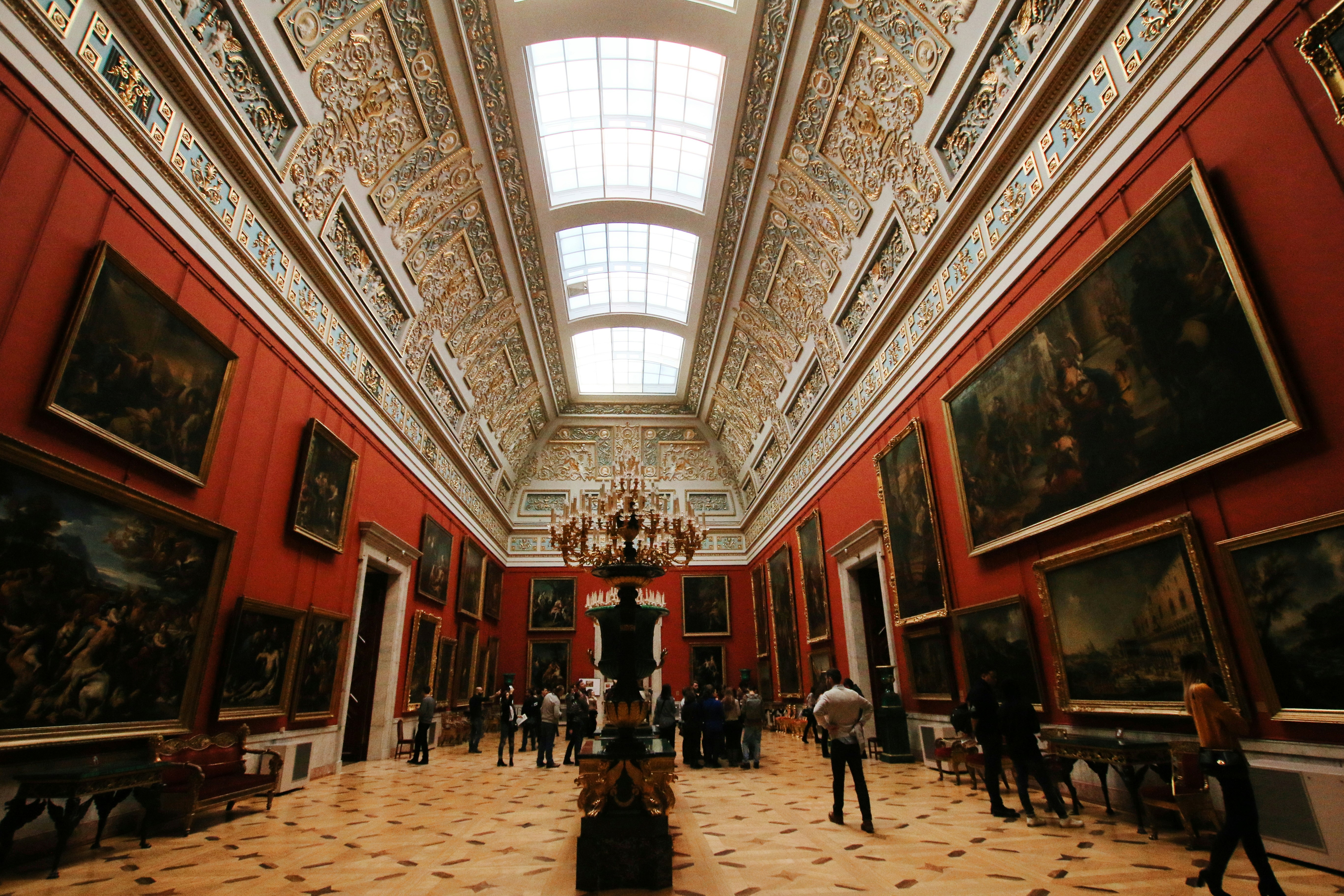
The Hermitage St. Petersburg, Russia
A Timeless Institution
As one of the oldest and largest art galleries in the world, The Hermitage offers both scale and substance. Established in 1764 by Empress Catherine the Great, it holds one of the most extensive art collections found anywhere, drawing millions of visitors annually.
Founded in the 18th century, making it one of the oldest major galleries globally
A central part of Russia’s cultural and political history
Vast network of six historic buildings, including the iconic Winter Palace
Home of Over 3 Million Artworks
Art enthusiasts can explore more than 3 million pieces housed within the museum’s sprawling collection.
Paintings, sculptures, decorative arts, and archaeological finds
Notable holdings include works by Leonardo da Vinci, Raphael, Rembrandt, and Rubens
A collection large enough that only a fraction is on display at any time
European Masters in Focus
The Hermitage places a strong emphasis on European artworks, spanning from the 13th to the 20th century. This curated journey through time provides insight into the evolving styles, influences, and themes of Western art history.
Italian Renaissance pieces and Flemish Baroque masterpieces
Impressionist and Post Impressionist works, including pieces by Monet and Cézanne
Special exhibits rotating throughout the year
Visiting the Hermitage is more than a museum stop it’s a historical deep dive into the evolution of European art through a distinctly Russian lens.
Tate Modern London, UK
Tate Modern doesn’t just showcase modern and contemporary art it defines it. Housed in a former power station on the Thames, this gallery pulls art out of the ivory tower and drops it right into daily public life. You walk through its oversized halls and it hits you: big ideas, loud emotions, stripped down aesthetics all under one roof.
The exhibitions are anything but timid. From Andy Warhol’s pop heavy critiques to Ai Weiwei’s hands on protest art, Tate Modern is where cultural heavyweights flex. And it’s not slowing down. Looking ahead to 2026, expect a slate of new installations focused on climate change, environmental decay, and the social ripple effects those issues carry. Less showy for its own sake, more urgent commentary on a world in flux.
Whether you’re a collector, creator, or just passing through with an eye for what’s next, this place keeps raising the bar.
Rijksmuseum Amsterdam, Netherlands
Stepping into the Rijksmuseum is like walking into a snapshot of the Dutch Golden Age. It houses some of the most iconic works by Rembrandt and Vermeer masters of light, shadow, and human nuance. “The Night Watch” and “The Milkmaid” alone are worth the visit, but they barely scratch the surface.
The museum’s recent renovation wasn’t just a facelift; it was a full reimagining. Galleries now guide visitors through immersive, story driven displays that lean into atmosphere and sensory detail. You’re not just viewing colonial era maps you’re standing where history unfolded.
Bonus: A canal boat tour leaves from right outside the museum. Take in the waterline views of Amsterdam before or after diving into four centuries of Dutch artistry. It’s a seamless blend of culture, history, and classic city charm.
National Gallery of Victoria Melbourne, Australia
The National Gallery of Victoria (NGV) holds the title of Australia’s oldest public art museum and it wears its age well. Since opening in 1861, the NGV has evolved into a cultural mainstay, housing tens of thousands of works that bridge time, geography, and voice. You’ll find everything from powerful Indigenous art to pieces by European masters like Turner and Picasso. It’s not just a museum; it’s a walk through layered histories.
But the NGV doesn’t stop at preserving the past. Each year, it commissions a bold contemporary installation from an international artist, transforming its spaces into talk worthy experiences that often break the internet. The mix of classic and cutting edge makes it one of the most versatile galleries on this list.
Add it to your itinerary if you’re after a gallery that manages to be both grounded and forward looking all while staying unmistakably Australian.
Tokyo National Museum Tokyo, Japan
Located in the heart of Ueno Park, the Tokyo National Museum is where centuries of Asian history come into quiet, striking focus. This is Japan’s oldest and most expansive art museum, with a collection that stretches back over a thousand years. From samurai armor to delicate scrolls, every artifact feels like a direct thread to the country’s past.
What sets this museum apart is how it follows Japan’s seasonal rhythm. Exhibits change with the months expect cherry blossom motifs in spring, moon themed art in autumn, and fierce, snow clad warriors in winter. The programming is as thoughtful as it is beautiful, making each return visit feel fresh.
The vibe here? Calm, introspective, and refreshingly low on noise. Solo travelers looking to slow down and absorb culture at their own pace will find it near perfect. Skip the crowds, stay a while, and let the past speak plainly.
Museu de Arte de São Paulo (MASP) São Paulo, Brazil
MASP doesn’t look or feel like your typical gallery. Its iconic red structure floats above the city’s main avenue, but it’s what’s inside that turns heads: a transparent display system that suspends artworks midair on glass easels. No cluttered walls, no ornate frames, just the art raw and unobstructed. It’s a visual clean break from museum tradition and a strong statement about making art accessible.
The museum’s collection spotlights Latin American modernist movements with serious intent. From Tarsila do Amaral to Diego Rivera, MASP gives regional artists the platform they deserve alongside European giants. The curation leans more contextual than chronological, making the experience feel more like a narrative than a history lesson.
Add to that an inclusive, community first approach: family friendly programming runs throughout the year, and bilingual tours make it easy for international visitors to immerse themselves without missing nuance. MASP doesn’t just display art. It opens it up, strips it down, and brings everyone in.